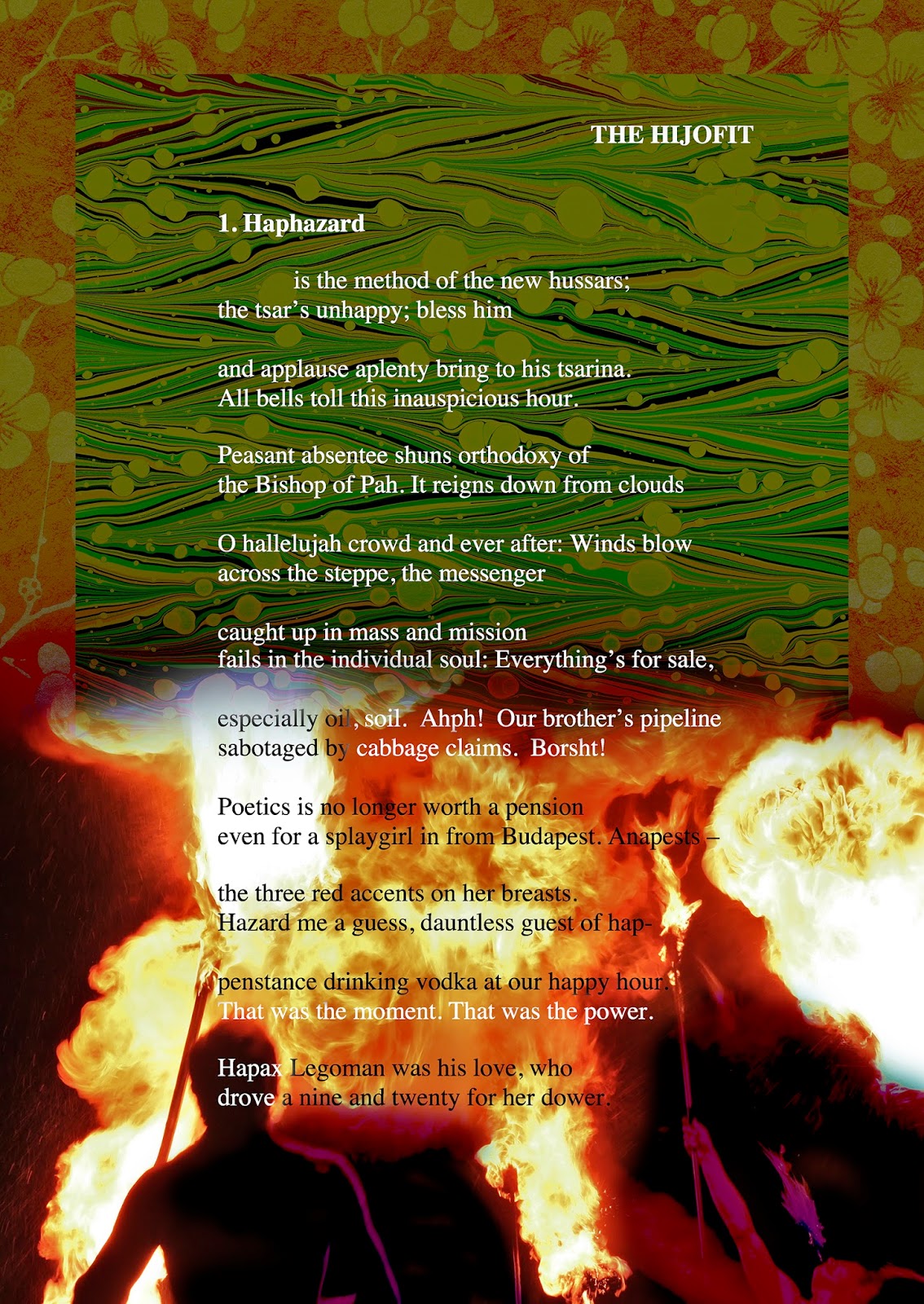
Ho|ma|ge to Sunface Deruin, image by Daniel Y. Harris
Society of the Sun
Lyn Hejinian
Baudelaire called the public, in
its wild enthusiasm for photography, “sun-worshippers.” They loved what they
saw. “From that moment onward, our loathsome society rushed, like Narcissus, to
contemplate its trivial image on the metallic plate.” Here is a photograph of a building in ruins.
The caption reads “Victoriously.” This is a politically-devastated landscape
and, although very differently, a politically-charged photo. We can see a
child’s shovel and pail in the foreground and some sea shells beside them. And
we can see a “Vacancy” sign in a window of a building off to the right of the
ruins. The photographer may be obsessed with death, or with fending it off. They
are not the same thing. The landscape is stark, but the rubble is minutely
textured, purveying pattern. Photography is perhaps the first of the
Enlightenment arts, utilizing the technology that the Enlightenment’s
anthropocentric view of creation assumes and fulfilling some of its not
entirely false promises. The photo-loving public can have its shadows, rendered
believable, prolonged indefinitely, and even immortalized. Photos can
contribute to the aesthetics of minutiae, with their promise of infinitude.
Attention to the miniscule (which has provided science with its own province of
sublimity) might stand as a counter to a concomitant awareness of orders of
magnitude that include atrocity, war, capitalism, and perhaps—though it may be
mortality’s saving grace—death. Indeed, photography enthusiasts might be better
described as worshippers of shadows, after-images, history. Even large format
photographs—as in Doug Hall’s magnificent digital C-print works, some measuring
as much as 4 by 5 feet—seem more immediate (though, paradoxically, less
intimate) than paintings. For intimate encounters we turn to time. It is there
that we feel the intimacy of other lives and others’ experiences of things.
True, as progenitor of the objective sciences, the Enlightenment can hardly be
deemed a wellspring of intimacy. Forget the selfie! I’m doing my best not to
contribute to the cult of surveillance. But, by bringing the objectifiable
world home, so to speak, the Enlightenment did, to some extent, increase the
human capacity for intimate experience—that is, for experiencing things
intimately, and hence inconclusively. Adorno, writing about the late poetry of
Hölderlin, speaks of inconclusiveness as an instrument of “the paratactic
revolt against synthesis.” “Hölderlin,” he says, “so transmutes the form of
unity that not only is multiplicity reflected within it—that is possible within
traditional synthetic language as well—but in addition the unity indicates that
it knows itself to be inconclusive.” Within the dark interior of the camera is
an hallucinating eye enchanted by the passing image of an emotional face or
pigeons circling under the sky. It sees things one can’t discern sufficiently
and are on their way to expiration, but the way is so long as to be
unimaginable except as an instantaneous, blazing flash in an otherwise soft
black depth that isn’t a space but a plunging of space too dark and empty to
see as anything at all. One can’t look directly at the sun, either, of course;
everything one has forgotten is in it. Near a set of keys, a hammer lies on the
table beside a paper napkin. A stuffed animal—a brown nubbled dog with splay
and floppy limbs—on its side in a chair; over the back of the chair a black
leather jacket is draped. This is yet another in a sequence of winter “spare
the air” days. The branches of the street trees (plum, gingko, sycamore, birch)
are leafless, but the yellow flowers of creeping woodsorrel are blooming in
front yards, median strips, and weed beds. There’s a used teabag on the napkin,
surrounded by an ochre stain. The newspaper carries an inky, uncontroversial
image of Martin Luther King Jr., photographed against an indistinct background.
It’s the annual tribute. The expression on King’s face blocks interpretation,
or, rather, that is exactly what he’s expressing: resistance to interpretation.
The story of everyday life (repetition) proceeds slowly. The story of young QJ
takes his entire lifetime to unfold.
Streets all around us like jawbones
bringing
marvels that rival a robin’s
and that’s real
’cause both are so common
—so common, so
come on, so common….
Carlotta snaps her fingers.
“Feelin!” she says. “Playing music’s useless,” says Diego; “that’s what’s good
about it.” “I don’t think it’s useless!” QJ brings both drumsticks down on the
high-hat, the right slightly before the left. “Streets all around us like
jawbones. Lot a things like that, around us like jawbones. Gives me a chance to
express myself.” “I’d say what you express is that you like to beat on things,”
says Carlotta. “Fuck, playing this shit is
useful,” says Flip. “Like how?” Didier Padilla Brown is hastily tuning his
guitar—pong pong, pang pang, ping ping—the harmonics match. He swings, strums,
bends, kicks. It is said of him that he has one eye too many, prompting one
pungent critic to comment that it is an irrelevance since Didier keeps it
closed. It’s an improviser’s eye. He turns it on the kids. “Listen up.” Didier
Brown values spontaneity, outbursts, “best after years of practice,” he says.
Everything about the past is to be remembered; “boundaries exist so you can
pound on them,” he says, “and the first beat’s not the one you’re going to
hear.” A helicopter passes noisily overhead, generally following Telegraph
Avenue north toward Berkeley on its way to drift over the early rush hour
traffic, locate a criminal, or hover over a protest. “What you are witnessing
is the beginning of the end of civil society.” The helicopters compete for the
acoustic space, cops loiter on the fringes of the crowd, one leans against a
sycamore tree. Now and then within the circuitries of communication the volume
of noise increases, sometimes aspiring to cause interference, sometimes
aspiring to overcome it. Take this little poem of Lyn Hejinian’s, for example:
wilt
unnamed
button
store it all
The tercet is spare, but
incautious. Its very brevity inflates it. It seems peremptory, or irascible. It
is certainly not gnomic; it is not trying to hold any of its energy in reserve.
It has a strongly expressive quality; something has excited emotion, but just
what that something is or was and what that emotion (or complex of emotions) is
remains unclear. But clarity is, obviously, not the point. That said, clarity
seems even less the point in P. Inman’s chapbook Ocker. It is either semantically protean or in ruins, radically
inconclusive or beyond repair.
oneitd , crine
mend zin
Perhaps the forces of history
have ravaged the words and phrases of the poem, so that what we have are only
its embattled, allegorical, fierce remains, or we are witness to those words
and phrases coming into formation. The poem presents us with something that
might have been said or that might be said yet. Gertrude Stein claims that
masterpieces “exist because they came to be as something that is an end in
itself.” In this respect, she says, they are “opposed to the business of living
which is relation and necessity.” Young lovers imagine their love to be just
such a masterpiece. As Kierkegaard’s pseudonymous B puts it, “The lovers are
deeply convinced that in itself their relationship is a complete whole that
will never be changed.” But it seems whole because it feels incontrovertible,
inevitable: “Romantic love manifests itself as immediate by exclusively resting
in natural necessity….” The same could be said of existence—one comes into
being from natural necessity, but in this case it’s less an inevitability than
through circumstantial fortune. The sequences of events resulting in a birth
are multiple, their sequentiality largely inadvertent, and perhaps from only
one of them might a birth have been reasonably predicted—though any particular
one couldn’t have been predicted at all. And, even when a child might have been
intended, the child was not itself a participant in the intention. But soon it
will have to realize that it exists. The Uzbek poet Muhammad Salikh has
credited that realization to one’s shadow. “I am a very young child,” he says.
“That’s the dream.” He says he is flying high above the desert. He swoops
through the air, his shadow racing to the left, then to the right, sometimes
shrinking into a valley or dry riverbed, sometimes burgeoning on top of the
dunes. He wants to stay in the sky forever, teasing his shadow. Suddenly, far
below him, he sees his mother standing in the desert. He lands beside her, and
she takes his hand. He tries to pull away. “Come fly,” he says, but his mother
points to his feet. His shadow has caught him and holds him to the sand. “That
is how I was born,” Salikh said. One’s shadow does more than supply one with a
caption. The allegorical comes affixed to remnants of the past of which it
speaks, but it can speak only incompletely and cryptically of the lost whole
(its true and proper time)—this is a point that Walter Benjamin makes—whereas
the shadow can extend into the future, and condense itself into the present, as
well as come out of the dark. Spinach frigate and ledger cello and churlish
Lily Ball and dysfunctional ephemera and puppetry and fusion flautist Samantha
Bell Chow. For the most part, I myself am not afraid of chaos but of fending it
off: the tedious work, the interminable sense of obligation, the compelling
call to return over and over again to the defense of a regimen of familiarity,
and of predictability, which runs counter to everyday life (repeating
repetition). Drowsily timeless colossus and lowercase pictography and pasta
putanesca and rain, at last. It’s hard to discern where history breaks off and
everyday life (implacably repetition) begins. But what about this? Near the
Oakland MAP a church is being demolished, the boards are being pried from the
studs, carefully stacked, incrementally hauled away, presumably to be reused.
The graceful, though somewhat squat, arched windows, empty of panes (which were
of plain, not stained, glass) having been removed and lean against the side of
a truck. The reader is not apt to read this as a speculative passage, she is
likely instead to take it as straightforward description, accurate to what it
purports to represent, even if what it presents is local to a fiction and
redolent with interpretation. What about this: The hills rising at the eastern
edge of the urban area provide a perspectival panoply, while to the west the
bay offers an endless prospect, a scintillating distance. One wide ugly avenue
is the only major street running between them; uninviting squat commercial
buildings, cheap motels, copy shops, and then a stretch of Indian restaurants
and a cluster of sari shops line it from end to end. Or this: A man approaches,
his feet and legs encased in armor made of shining silver scales. The front
edges of his armor boots are decorated with curling silver claws much as the
prow of a ship might bear a masthead in the form of a nymph whose long curls
blow out over the waves. A man approaches, his feet and legs encased in armor
made of shining silver scales. The front edges of his armor boots are decorated
with curling silver claws much as the prow of a ship might bear a masthead in
the form of a nymph whose long curls blow out over the waves. A man approaches,
his feet and legs encased in armor made of shining silver scales. The front
edges of his armor boots are decorated with curling silver claws much as the
prow of a ship might bear a masthead in the form of a nymph whose long curls
blow out over the waves. A man approaches, his feet and legs encased in armor
made of shining silver scales. The front edges of his armor boots are decorated
with curling silver claws much as the prow of a ship might bear a masthead in
the form of a nymph whose long curls blow out over the waves. Each element of
the work, every particular, exists as a point of encounter, rather than of separability;
each particular serves as an intersection, a portal, a source of energy, and a
point of departure (rather than terminus). In his old age, the writer James
Earl French says he no longer has the energy to express his ideas, his greatest
pleasure now is in getting new ones and he acquires them with a sense of
urgency, he reads, he takes notes, I’ll never do anything with them, he says.
He has lost interest in depicting the world as it appears to him; he has lost
his interest in offering his particular, peculiar perspective on things. I want
to know the world as it is, not as I see it, he says, but how is it? “That
question’s not so obviously political,” says Jean Day, “maybe not political at
all.” Reality—the given—is the problem that constrains objectivity, prompting
withdrawal. “Impoverished sense is the real problem,” Jean says, brushing her
right hand gently in the air as if to move the statement aside. But of course
everything is imminent in anything, with corresponding troubles and vexations, things
in need of attention, bringing many bits that concern us, their pertinent
worries and the accompanying worrying. Time gets intersected by the comings and
goings of its dramatis personae: dog walker, truck driver, short order cook,
oncology nurse, barista, florist, bank teller, dog walker, student, civil
rights lawyer, electrician, figment of imagination. Real shadows are subject to
the time of day, and to the position of the sun. What does one do with the
excitement one feels when in one’s excitement one becomes exciting and excites
awareness of the excitement and the exciting? And for how long can one do it?
Notes
“From that moment onward, our loathsome society…”: see Walter
Benjamin, The Arcades Project; translated by Howard Eiland and Kevin McLaughlin
(Cambridge, MA and London, UK: Harvard University Press, 1999), 691.
“Hölderlin,” he says, “so transmutes the form…”: Theodor W. Adorno,
“Parataxis; On Hölderlin’s Late Poetry,” in Notes
to Literature, volume two; tr. Shierry Weber Nicholsen (NY: Columbia
University Press, 1992), 136.
oneitd , crine / mend zin: P.
Inman, Ocker (Berkeley: Tuumba Press, 1982), unpaginated; first poem.
Gertrude Stein claims that masterpieces: Gertrude Stein, “What Are
Master-pieces and Why Are There So Few of Them,” in Gertrude Stein: Writings 1932-1946; edited by Catherine R. Stimpson
and Harriet Chessman (NY: The Library of America, 1998), 358.
“The lovers are deeply convinced…”; “Romantic love manifests
itself…”: Soren Kierkegaard, Either/Or, Part II, ed and trans by
Howard V. Hong and Edna H. Hong (Princeton: Princeton University Press, 1987),
21.
The Uzbek poet Mohammad Salikh: in conversation, Moscow, 1985.
“Emotional excitement invites our reflecting…”: Charles Altieri, The Particulars of Rapture: An Aesthetics of
the Affects (Ithaca, NY and London: Cornell University Press, 2003), 167.
Lyn
Hejinian is a poet, essayist, teacher, and translator. Her academic work is
addressed principally to modernist, postmodern, and contemporary poetry and
poetics, with a particular interest in avant-garde movements and the social practices
they entail. Her most recent book is The
Unfollowing (Omnidawn Books, 2016). Other volumes include The Book of a Thousand Eyes (Omnidawn
Books, 2012) and The Wide Road,
written in collaboration with Carla Harryman (Belladonna, 2010). And in fall
2013 Wesleyan republished her best-known book, My Life, in an edition that includes her related work, My Life in the Nineties. Wesleyan is
also the publisher of A Guide to Poetics
Journal: Writing in the Expanded Field 1982-1998, and the related Poetics Journal Digital Archive, both
co-edited by Hejinian and Barrett Watten. She is currently the co-director
(with Travis Ortiz) of Atelos, a literary project commissioning and publishing
cross-genre work by poets, and the co-editor (with Jane Gregory and Claire
Marie Stancek) of Nion Editions, a chapbook press.